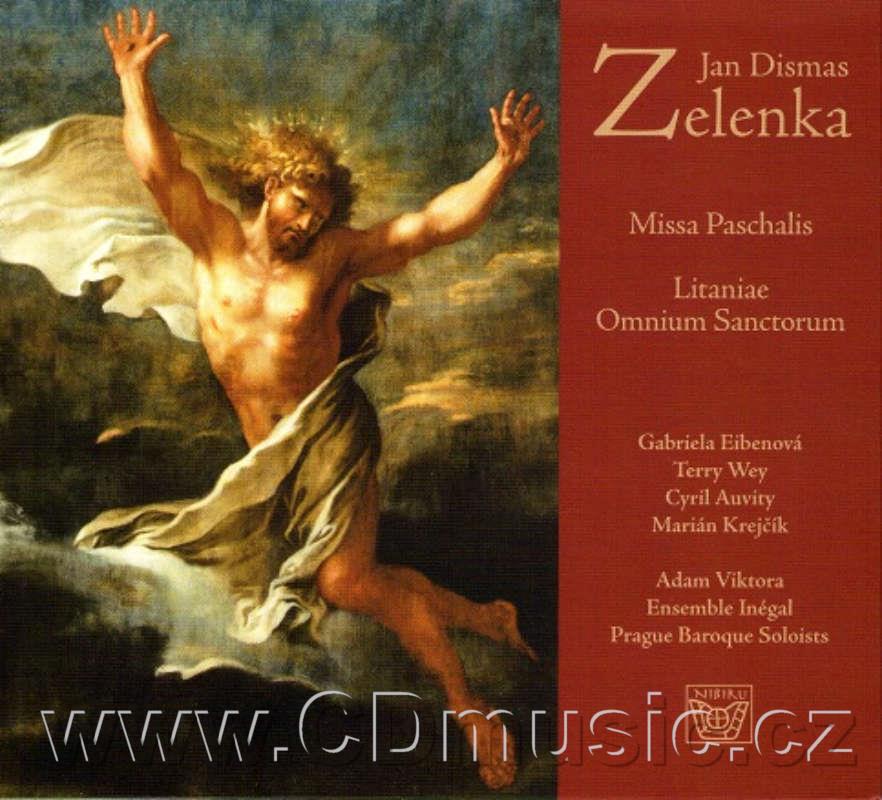
Jan Dismas Zelenka – Missa Paschalis ZWV 7, Litaniae Omnium Sanctorum ZWV 153 / C.Auvity, M.Krejčík, G.Eibenová, T.Wey, V.Čížek / Prague Baroque Soloists, Ensemble Inégal / A.Viktora
Podrobný popis
Jan Dismas Zelenka (1679-1745) – Missa Paschalis ZWV 7 (1726; revised early 1730s) *
Kyrie
1. Kyrie eleison I 2:52
2. Christe eleison 2:31
3. Kyrie eleison II 1:19
Gloria
4. Gloria in excelsis Deo 2:27
5. Domine 250
6. Qui tollis peccata mundi 2:13
7. Quoniam tu solus Sanktus 2:00
8. Cum sancto Spiritu 0:29
9. Amen 1:53
Credo
10. Credo in unum Deum 1:25
11. Et incarnatus est 1:22
12. Crucifixus 1:27
13. Et resurrexit 1:38
14. Amen 1:58
Sanctus
15. Sanctus 1:09
16. Benedictus 5:31
17. Osanna in enexelsis 0:25
Agnus Dei
18. Agnus Dei 2:14
19. Dona nobis pacem 1:23
Jan Dismas Zelenka – Litaniae Omnium Sanctorum ZWV 53 (1735)
20. Kyrie eleison 3:38
21. Pater de coelis 6:24
22. Sancte Petre 2:51
23. Propitius esto 1:58
24. Ab ira tua 3:39
25. Peccatores 1:53
26. Ut nos ad veram 6:50
27. Agnus Dei 3:43
Total time 68:21
Cyril Auvity tenor (7,11,24,25), Marián Krejčík bass (7,25,26), Gabriela Eibenová soprano (5,11,16,21,26), Terry Wey alto (2,7,11,21,24,25)
Ensemble Inégal, Prague Baroque Soloists
violin: Peter Zajíček, Simona Hurníková, Eva Kalová, Elen Machová, Magdalena Malá, Martina Stillerová, Petra Ščevková, Adéla Štajnochrová, Simona Tydlitátová, Petr Zemanec
viola: Jan Grener, František Kuncl, Michal Dušek
theorbo: Jan Čižmář
bassoon: Kryštof Lada, Petr Budín
organ: Vladimír Roubal
cello: Jonathan Pešek, Petr Mašlaň, Dalibor Pimek
double bass: Ondřej Balcar, Alessandro Giachi
flute: Martina Bernášková, Lukáš Vytlačil
oboe: Markus Müller, Tereza Pavelková
clarino: Hannes Rux, Almut Rux, Karel Mňuk, Jaroslav Rouček
kettledrum: Pavel Rehberger
choir
soprano – Yvetta Fendrychová, Alena Hellerová, Stanislava Mihalcová, Lucie Rozsnyó, Kamila Zbořilová
alto – Daniela Čermáková, Lenka Čermáková, Marta Fadljevicová, Dora Pavlíková, Pavla Štěpničková
tenor – Václav Čížek, Hasan El Dunia, Tomáš Lajktep, Ondřej Múčka
bass – Marian Krejčík, Roman Hoza, Aleš Procházka, Martin Vacula
Adam Viktora conductor
* World Premiere Recording
Stereo digital studio recording, 2013.
This recording of Missa Paschalis and Litaniae Omnium Sanctorum contributes to the remarkable renaissance over the past decades of the music of Jan Dismas Zelenka (1679-1745), the Bohemian musician who came to Dresden to serve at the courts of Saxon Electors and Kings of Poland: August II and, from 1733, August III. It was the devout Habsburg wife of August III, however, who appears to have wielded the great influence upon the quality of music composed and performed in Dresden’s royal Catholic court church. Throughout her life in Dresden, Maria Josepha took an active interest in this aspect of worship, requesting the elevation of certain feasts through the composition and performance of sacred music. For exequies, in particular, this queen specifically requested Zelenka to take charge of the music on many occasions. When the castrati of Dresden’s renowned Hofkapelle baulked at singing for certain services of the church, it was she who resolved the impasse. For example, when they claimed that they were not obliged to sing the requiem mass on 3 November 1733 (the anniversary of the dead members of the Society of Jesus: Anniversarium omnium in Societate Defunctorum) the Diarium Missionis Societatis Jesu Dresda kept by the Dresden Jesuits who staffed the royal chapel reported that representation was made to the queen, who immediately ordered the requiem mass to be sung by these singers, and was herself present in the chapel.
These two large-scale works by Zelenka were composed at key moments of his life. Missa Paschalis (ZWV 7) comes from the year 1726 when he appears to have begun to aspire to a position at the Dresden court as a composer rather than one of performer: Litaniae Omnium Sanctorum (ZWV 53) was almost certainly written in 1735 soon after this ambition had been realised. Moreover, these two works are among the many sources that go a long way towards negating the popular impression that Zelenka’s music was unappreciated during his lifetime and never heard after his death. On the contrary, sources kept outside Dresden of both Missa Paschalis and Litaniae Omnium Sanctorum reveal that Zelenka’s music lived on into the nineteenth century – well after his death.
(Nibiru 2013)